
Roman History Today
By Michael Sumpter
Rome has a history longer and richer than most of the nations to ever exist. Rome is also the largest city in modern day Italy, contributing greatly to the global economy. The question is, how do these two national identities coalesce? In order to understand the answer to this, we must first understand the historical journey that Rome has been through
Rich History of Rome (In a Nutshell)
Ancient Rome
The nations of Ancient Rome span roughly a millennium beginning several centuries before the birth of Christ (760 years) and lasting several centuries after the death of Christ (476 years). Throughout the reign of the ancient nation, there were several forms of government in power. Rome was originally a monarchy ruled by a king. Then, the monarch was replaced by the Republic of Rome, which was ruled by the Senate. Finally, the Empire of Rome emerged, which was ruled by an emperor. Across the centuries, countless unforgettable events took place that modern day Italians refuse to let time erase.
Kingdom of Rome
The Kingdom of Rome is a much lesser known chapter of Roman
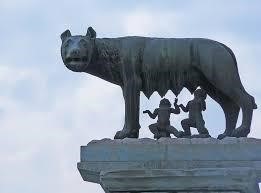
history in today’s society, but is crucial to understanding the modern culture of Rome nonetheless. The kingdom of Rome began following the legend of Romulus and Remus. This famous story tells of a she-wolf finding the abandoned babies Romulus and Remus and nursing them to become strong men. The first king of Rome was Romulus. The monarchy of Rome ruled for roughly 200 years, and was then replaced by the aristocratic Roman Republic under the notion that this would prevent any one man from having too much power.
Republic of Rome
The Republic of Rome was in power for roughly 500 years, and by this point in time the Roman nation was vast and internationally formidable. The government was largely successful in expanding their greatness, but when the powerful general Julius Caesar refused to give up his power and become dictator, he was assassinated. Afterwards, Augustus became the first emperor of Rome.
The Empire of Rome
The Empire of Rome is undoubtedly the most well known stretch of Roman history. The Empire was also the longest lasting form of government in Rome, so this is where the bulk of the cultural history that remains today stems from. Many of the ancient cultural sites that we see in Rome today were either erected by a great emperor or in honor of one. The most recognizable piece of Ancient Roman history remaining today is the Colosseum which was commissioned by Emperor Vespasian. The Pantheon was built by Emperor Hadrian. Landmark victory columns honoring other great Emperors like Marcus Aurelius, are also prominent in the city today. The empire of Rome has a rich, unforgettable history producing culture and local pride that modern day locals cherish.
The Catholic Church
Nothing lasts forever; the Roman empire does not exist today. The downfall of the Roman Empire made way for the Catholic Church to become the dominant power in Europe. Italy became the heart of Catholicism and eventually hosted construction of the Vatican capital. The dominant religion all throughout Europe was Catholicism, and no pagen gods were allowed to be publicly worshipped.
What Modern Romans Think of What Past Romans Built
Walking through Rome today offers countless historical landmarks that are highly valued by the locals and tourists alike. These landmarks serve as a centerpiece in understanding Italian culture.
Colosseum today-Ancient and Modern Coalesce
The Colosseum is a site that is known in every corner of the globe, and stands as a monument to the power and achievement of Ancient Rome. The Colosseum was commissioned by the Emperor Vespasian in 72 AD and construction was completed 8 years later, when his son Titius was emperor. If the Colosseum is mentioned in conversation, the first place someone’s mind will go is to the gladiator fights. There is no denying that these gladiatorial events took place here, but the truth of history is usually not quite as gruesome as pop culture sometimes makes it look. In reality, only 1 in 10 gladiators were killed in the Colosseum, and about 1 in 5 were able to win their freedom after a few years. (These are the details that are lesser known because they make for less exciting movies). The Colosseum hosted several types of events, the most famous being the gladiatorial combat, hunt style games, and even small naval battles. Each of these events hosted in the grand arena was of a violent nature, this is something that is associated with the image of Rome. I do not think it would be surprising to find that local Romans dislike the Colosseum and being associated with its barbaric nature. However, this is not the case.
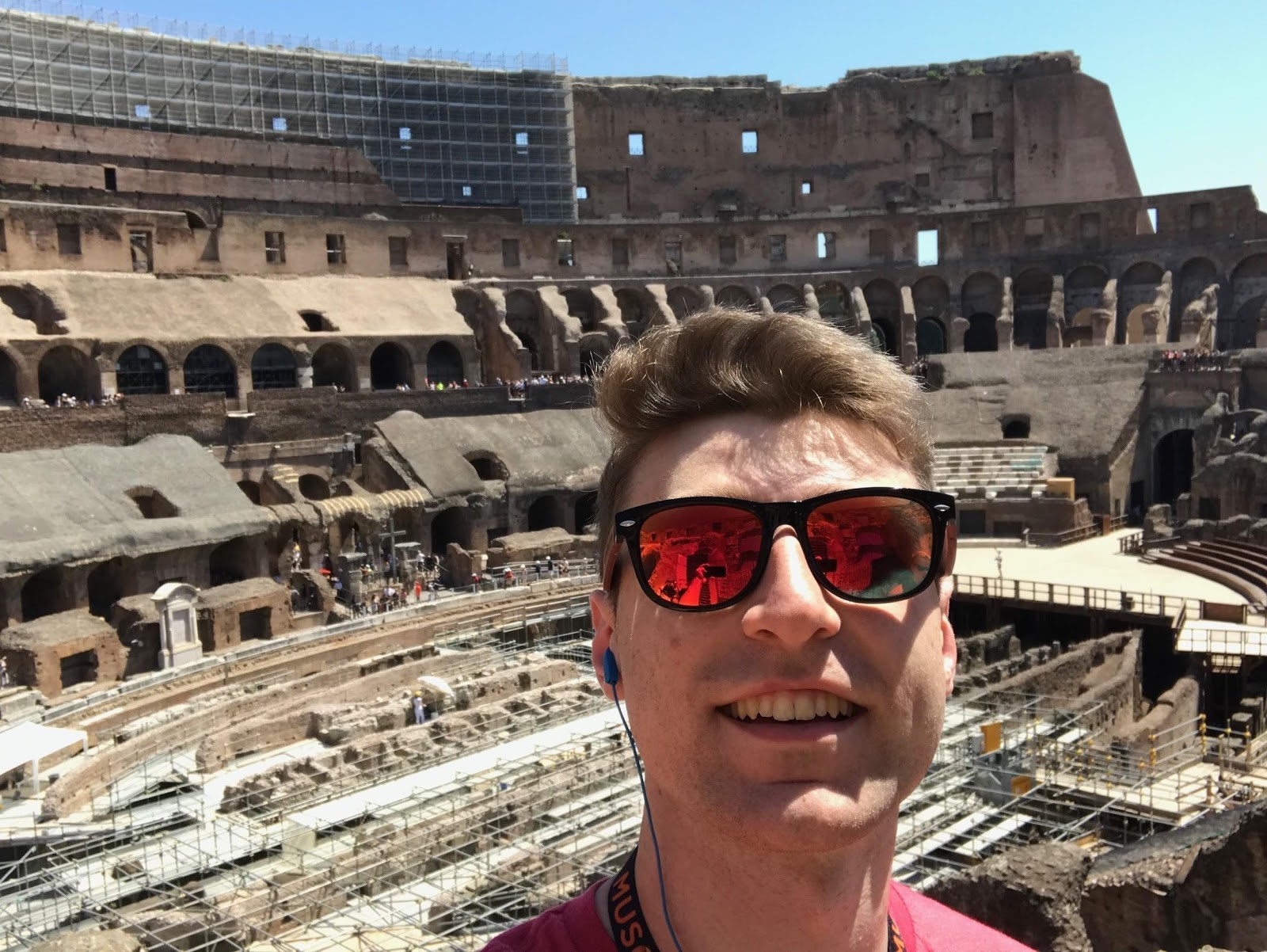
The Colosseum ruins remain today in downtown Rome; it is not in pristine condition, but it is still possible to feel the history when you look up at it. Romans do not shy away from the history surrounding this landmark; it is part of their history and culture. The Colosseum does not stand isolated; it has been completely incorporated into the hustle and bustle of everyday life here in Rome. It is not uncommon to see young, local Italians wearing shirts with references to Ancient Rome. Locals do not dislike the Colosseum; they love it. To modern day Romans, the Colosseum is just one piece of a story that makes them so unique and their culture so much more complex than countless other nations, U.S. included.
My experience of the Colosseum while in Rome was a bit of a roller coaster. All my life I had been learning about the Colosseum and seeing images of the ancient arena both in academic and non-academic settings. Constantly seeing images of the Colosseum, especially reanimated versions of it in pop culture, resulted in my imagination forming this extremely massive structure that will be larger than anything else I have ever seen. So on our first day in Rome, my excitement to see it was so great I forgot I was jet-lagged. Once I finally saw the Colosseum, I was a little surprised that it barely bested the surrounding buildings in height. Then I thought to myself maybe once I am inside the history will come to life. It may be cheesy to say, but walking up the inner stairs of the ancient Colosseum rekindled my hope, and then the precipitate entrance into the arena blew me away. I could really feel the history, and there is a lot of it to feel.
Pantheon today-Culture evolves
The Pantheon may not be as well known as the Colosseum, but is still internationally recognizable. “Pan” meaning all, and “theo” referring to gods is how the building was named, it was a temple to all the gods. Construction of the Pantheon was completed by Emperor Hadrian in 125 AD. Several centuries later when the Catholic church rose to power in Europe, the Pope did not like the idea of such a grand temple honoring pagen gods. The pope rededicated the Pantheon to honor God in the Catholic faith only. This is the version of the Pantheon that can be visited today.
You might say that with the rededication of the Pantheon to exclude many religions, the Pantheon isn’t true to its history. These could lead you to think that since Italians “stick to their guns” when it comes to the Colosseum, they would not accept this new Pantheon over the ancient all-accepting Pantheon. However the national religion of modern day Italy is still Catholicism, and therefore the majority of Italians practice the faith in its current form in the Pantheon. Modern day Italians are very accepting of this ancient temple in both its old and newer ideals. The Pantheon is a good example of how the culture of a nation is not something set in stone, but something that is made up of many components that are ever changing and evolving.
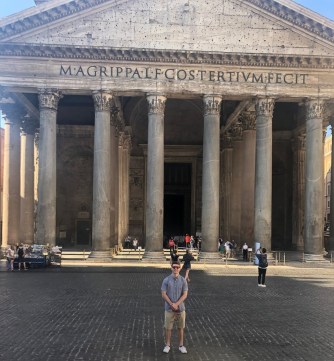
My experience at the Pantheon is more straightforward than with the Colosseum. In contrast to the Colosseum, I only learned about the Pantheon two years before coming to Italy. With this in mind, my vision and understanding of what to expect was much more limited, and not built up to any unrealistic expectations. After a week in Rome, we were walking as a group to visit the Pantheon, and I was excited, but not to the point that you could see it on my face. When we turned the corner and were suddenly right in front of it, I could not believe it. I was blown away. The Pantheon is huge! Everybody who speaks of Rome is so busy talking about the Colosseum that they forget to tell you about the biggest unsupported concrete dome in the world: the Pantheon! In addition to my appreciation for its architecture, I am Catholic and appreciated the faith of the now practicing Catholic Pantheon.
My Main Man Marcus Aurelius-Just for Fun
Walking through the city of Rome today, there is more than one victory column ready to be stumbled upon. The one I have in mind is the Column of Marcus Aurelius. Marcus Aurelius was emperor of Rome from 161-180 AD, and he is considered to be the last of what came to be known as the “five good emperors.” These are emperors that are all revered not only for their achievements during their reign, but also for the type of people they were. It is even noted that none of these emperors had a Praetorian guard while in Rome because the people loved them so much; they didn’t need one. Marcus Aurelius also became famous as the philosopher-emperor because of his devotion to the Ancient Greek teachings of stoicism. While away during military campaigns, Marcus took autobiographical notes interwoven with themes of stoicism; these notes were later termed “The Meditations of Marcus Aurelius.”
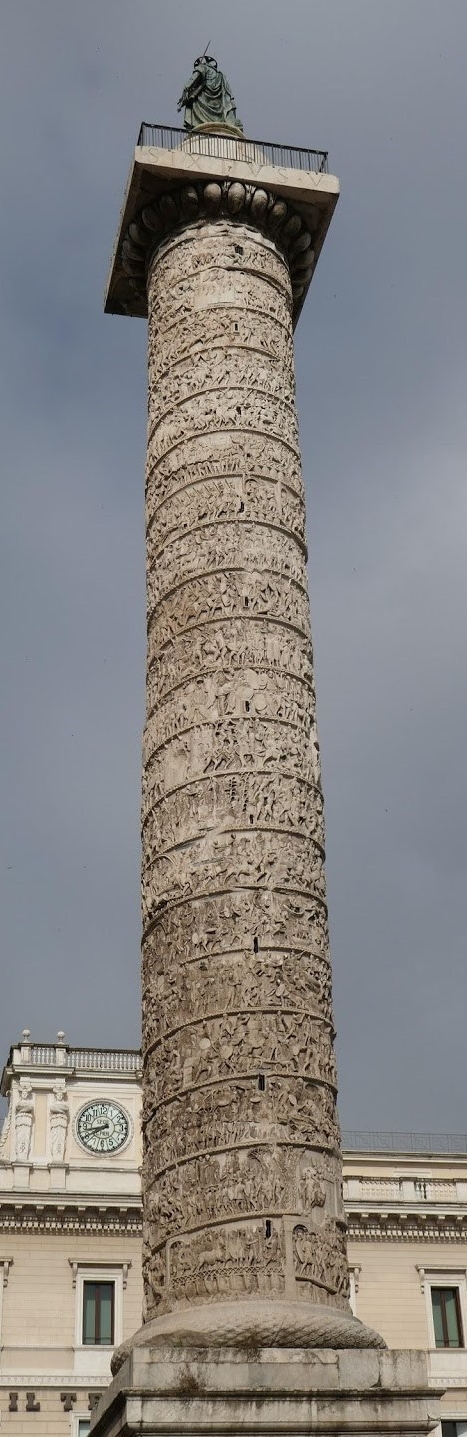
Of course, Marcus Aurelius would not have a victory column in the heart of Rome just because he was a “good guy”. Marcus spent most of his rule away from Rome due to war. The Marcomannic war, for which the column was carved, lasted dozens of years on multiple fronts, but Marcus was largely successful. With each great victory, a new row/victorious story was added to the column for his people to see.
Modern day Romans may value this landmark more highly even than the Colosseum, not because it reels in the tourists and boosts the economy (it’s free to see), but because of what it stands for. This is a landmark honoring one of the most humble, benevolent, and successful rulers of all time. It is a monument proving that Rome was not built exclusively by vile rulers. It is a monument honoring an exemplary leader and person. The column is sometimes referred to by locals as the heart of Rome.
My experience with the column of Marcus Aurelius is more with Aurelius himself. I did actually stumble upon the column by accident one night, but I had no idea what it was. After I began to learn about who Marcus Aurelius was, I began to realize why he is one of the only emperors with a landmark honoring him. I personally am a big fan of Aurelius’ beliefs. He lived by ideals like “treat all others fairly and justly, regardless of the circumstances.” Marcus Aurelius is just an ancient ruler who I have grown to respect greatly, similar to the local Romans.
These are simply three examples of how Rome’s long and diverse history is incorporated in modern day Rome. Some aspects of history are embraced and advertised, some are accepted in a modified nature, and some are embraced but not advertised.
About the Author
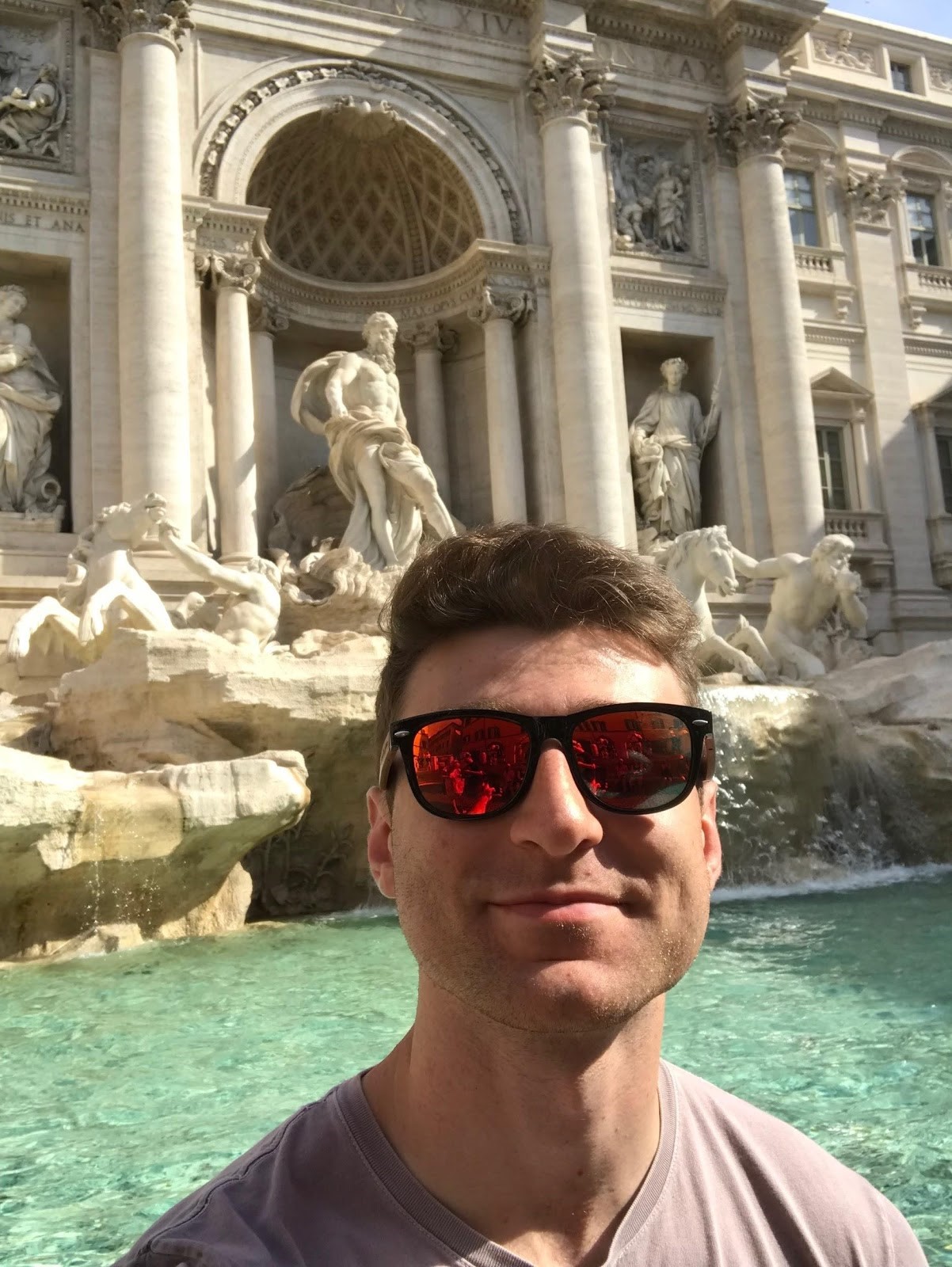
Michael Sumpter is a senior at Colorado State University in Fort Collins, Colorado. He studies Nutritional Science with and emphasis on biochemistry and biomedical science. He has a passion for many different subjects, and almost every discipline of science. History is something that he has always loved, along with ancient culture and just the idea of seeing something completely new. These are the underlying causes of what drove him to spend the summer in Roma. Back in Colorado, he loves to partake in traditional outdoor activities like hiking, camping, and snowboarding. As great as Italy is, he can’t wait to be back in the U.S.!
 Ragazzi a Roma